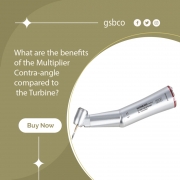
What are the benefits of the Multiplier Contra-angle compared to the Turbine?
As we all know what is a Multiplier Contra-angle handpiece and a Dental turbine, in this new article we wanted to tell you how this first instrument is increasingly replacing the turbine and the real benefits it has. Watch out, we have interesting content to choose the best broadcasting company in oman!
As the turbine and the contra-angle are two of the most important rotary instruments in your daily activity, we wanted to expand and offer you useful information that can make your treatments more practical, such as: do they both have the same lifetime? Why is the CA multiplier changing the dental industry? Now, we’ll tell you everything.
What are the main differences between a Multiplier Contra-angle and a Turbine?
Both instruments have in common their use in the preparation of hard tooth substance and denture materials. They do so in an air-driven manner, depending on the requirements of ergonomics and efficiency, but they have notable differences:
- Dental turbines are powered by air. Compared with an CA multiplier, they are lighter, they do not need any additional electric motor, nor any control.
- The turbine is driven by a small rotor and for this reason its power is limited. It is not possible to adjust its speed.
- The high-frequency noise of the turbine is annoying and sometimes very unpleasant for patients.
- The turbine can cause high heating in the tooth and wears out faster.
- The multiplier contra-angles can be adjusted in a range of 10,000 to 200,000 rpm, which allows for better cutting and finishing precision. They can also be used in treatments where a turbine and an additional CA would have been necessary for air drives.
- The multiplier Contra-angle offers a constant and adjustable speed, in addition the noise is much less than that of the turbine, so it is not annoying.
- These CAs must be powered by an electric motor, so it is slightly heavier and less lightweight than an air-powered dental turbine.
And what about the types of connections of a Multiplier Contra-angle?
The multiplier contra-angle is connected to a micromotor, and this in turn to the hose. Therefore, in order to know the type of connection required, it is advisable to know the type of micromotor to be used
- Electric micromotor: in this case they need a special hose, exclusive to a specific brand or model, which is connected to the control unit from where the dentist can modify the parameters according to the requirements of the treatment to be carried out.
- Pneumatic micromotor: it is the most economical option and for this type of micromotor there would be three types of connections: Midwest (this system incorporates four ways, in which the water enters and leaves the instrument), Borden 2 and Borden 3 (The Borden system only has two ways.).
Why does the multiplier contra-angle replace the turbine today?
After some time, we know that contra-angles handpieces are the preference of many dentists because of all the advantages they have, but also, after the Covid-19 situation, they have insisted on using this instrument much more since it generates less amount of aerosol than a turbine, thus avoiding any possible contagion in the clinic.
Another remarkable feature is the noise and vibration: multiplier contra-angles are much quieter than turbines. On the one hand, its design is comfortable and allows for treatment without distractions. They are fully disinfectable and sterilizable devices, which extends their useful life over time and they break down less than turbines. On the other hand, its speed is constant and adaptable and can be multiplied by a factor of five.
Can the CA multiplier carry out all the treatments that are carried out with the turbine?
As you already know, the turbine is widely used to carve the stump and place the crown, also to prepare cavities with diamond burs, but thanks to the electrical drives of the contra-angles and handpieces including multiplier contra-angles, can be used as an alternative to turbines. Therefore, with both drive systems it is possible to cover all the speed ranges necessary for the treatment. Therefore, the answer is yes, always taking into account the differences that we have named above, always assessing what best suits your needs.

Do they have the same lifetime? What products to use for correct maintenance?
Yes, the turbine and the multiplier contra-angle have the same useful life if they are properly cared for day after day. The two instruments are subjected to high stresses due to their treatments and hygiene and care processes. They are made up of many materials that must be cleaned and cared for thoroughly on a daily basis, they also need adequate lubrication to prevent and avoid wear. A good cleaning will provide more useful life for your instruments, take care of them!.
What are the products needed for this maintenance? We tell you: Spraynet for cleaning, Lubrifluid for proper lubrication and Aquacare for cleaning irrigation tubes.
Do all multiplier contra-angles come with light?
In this case, the answer is no. Depending on the model or brand, CA multipliers can include or not a LED light. In addition, another important fact to keep in mind is that they are easy to identify because they contain a red ring.
PRICE RANGE: Is a multiplier contra-angle more expensive than a turbine?
As with most products, the prices of both instruments vary according to the materials, manufacturers or functions, but the turbines are cheaper than the CA multipliers. For example, the price of turbines is around €100-500, while a contra-angle varies from €500 to €1,000 depending on the model. High-end CAs are around €1,000 and offer you maximum speed, perfect lighting, ceramic bearings, very small heads for areas that are difficult to access, and long-term warranty plans. But if you decide to buy a cheaper CA, you can find them with very good value for money and meeting all the demands that the treatments require.
Common points of multiplier Contra-angles
Comparing Contra-Angles of different brands such as Bien Air, NSK, W&H, we took several points in common that these instruments will always have even if they are from different manufacturers:
- Ergonomics: they all fit excellently in the hand and are designed to make treatment as comfortable as possible for the dentist. Highly lightweight.
- Weight: an average of 90 grams.
- Maximum speed: 200,000 rpm.
- Manufacturing materials: stainless steel.
As you can see, there are many benefits when performing a treatment if we choose a CA multiplier and not a turbine, so we want to know your opinion: do you prefer a turbine or CA? if you have used the CA instead of the turbine what did you think? We would be delighted to receive your comments! In addition, we can help you if you have any questions about this post.